Food Hygiene Ratings in Leeds: What 0 to 5 Means and How the City Scores
What each food hygiene score from 0 to 5 means, how three marks add up to it, and how Leeds's 7,685 food businesses split by score, postcode district and trade, from the Food Standards Agency record of 12 November 2026. Counts only, no names.
Updated
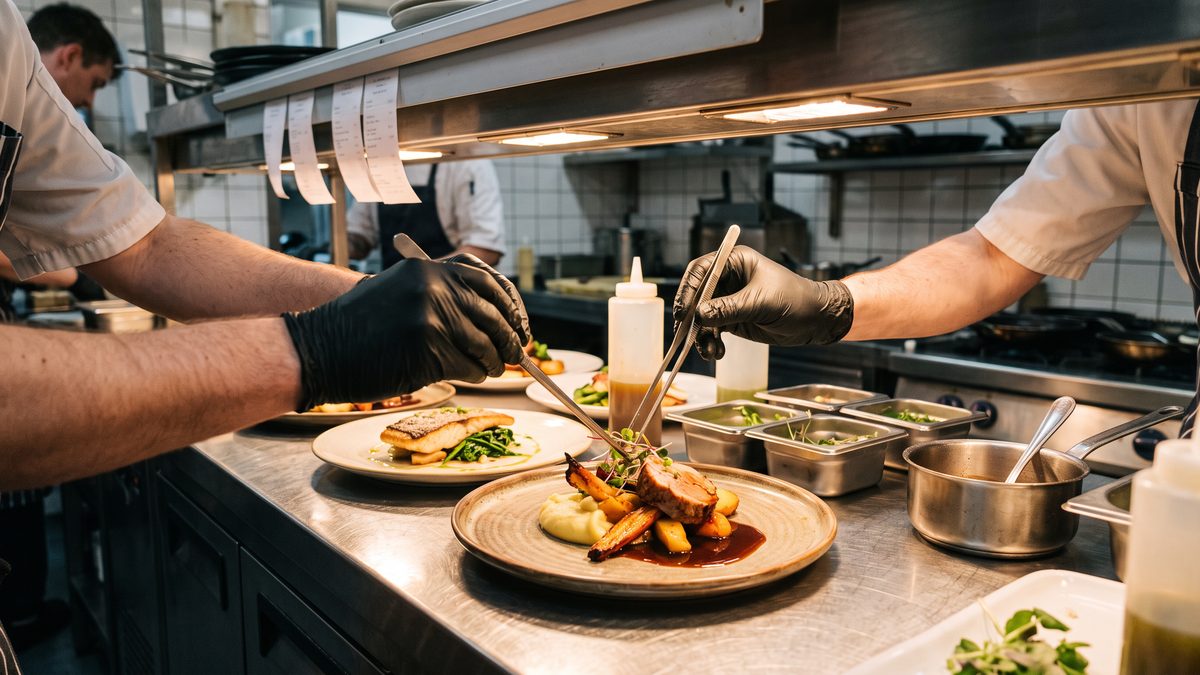
Every café, takeaway, pub kitchen, school canteen and home baker in Leeds that sells food to the public has to register with Leeds City Council, and one of the council's food safety officers then inspects it. The officer's verdict becomes a number from 0 to 5 on the Food Standards Agency's ratings site, where anyone can look it up for free.
This page counts how the whole city scores, by postcode district and by kind of business, without naming a single business. It then shows how three separate marks add up to one number, what a business can do when it disagrees, and how to check the one in front of you.
Leeds food businesses, counted by district and trade
Choose a postcode district (the first half of a postcode, such as LS6) and a kind of business. The table counts how many carry each score on the Food Standards Agency record of 12 November 2026.
The record lists 7,685 food businesses in the Leeds City Council area, which reaches Otley, Wetherby, Rothwell and Morley as well as the city centre. Districts with fewer than 30 records are grouped under "Other".
| Score | What the Agency calls it | Businesses | Share of the scored |
|---|
A district with fewer 5s mostly reflects the mix of food businesses in it and the date of their last visit. Across the city, takeaways and small shops score lower than schools and care homes, so a district full of takeaways will look weaker without any single place being worse.
Which trades score highest, and which lowest
Share of the scored businesses holding a 5, city-wide. The bar is the share, the figures are the counts behind it.
| Kind of business | Scored | Hold a 5 | Score 2 or less | Share holding a 5 |
|---|
Three marks, one number: how a score is built
The officer gives three marks in penalty points, so a low mark is good. The Agency's brand standard turns them into the 0 to 5 score in two steps: add them up, then check the worst single mark.
| Total of the three marks | Worst single mark may not exceed | Score |
|---|---|---|
| 0 to 15 | 5 | 5 Very good |
| 20 | 10 | 4 Good |
| 25 to 30 | 10 | 3 Generally satisfactory |
| 35 to 40 | 15 | 2 Some improvement necessary |
| 45 to 50 | 20 | 1 Major improvement necessary |
| Over 50 | Any | 0 Urgent improvement necessary |
The three marks are how hygienically food is handled, the physical condition of the business and confidence in how it is managed. Handling and structure take 0, 5, 10, 15, 20 or 25. Management takes 0, 5, 10, 20 or 30. A business whose worst mark is too high drops down the table until it fits.
Try the arithmetic
We ran this rule over all 5,584 scored Leeds businesses, using the three marks the Agency publishes for each, and it reproduced every one of the scores.
Where Leeds businesses lose points
Share of the 5,584 scored businesses that carry any penalty at all in each mark. A perfect 0 in all three is not needed for a 5, which allows up to 5 points in each mark.
| Mark | Businesses with a penalty | Share of the scored |
|---|---|---|
| Condition of the premises | 3,702 | 66% |
| Confidence in management | 3,400 | 61% |
| How food is handled | 2,401 | 43% |
Buildings lose points more often than cooking practice does. The structure mark covers cleanliness, layout, lighting, ventilation, pest control and other facilities, so a kitchen can handle food well and still lose points on the building around it.
When a rating is missing, old or different at the door
No score at all
1,898 Leeds records, about 25% of the list, read "awaiting inspection". A new business is registered first and inspected afterwards, and the council adds it to the food register within 30 days of the form.
201 more are exempt: low-risk shops that sell only wrapped food needing no fridge, and childminders or carers working from home.
An old date
The median scored Leeds business was last inspected 567 days ago, about a year and a half. 1,623 of them, 29%, carry a date more than three years old, and 1,486 were seen in the past twelve months.
The Agency says visits run from every six months for the riskiest premises to every two years for lower risk, and longer for very low risk.
A sticker that disagrees
A new score takes time to reach the website, since councils upload at least every 28 days. A business may also be appealing: in that case the record reads "awaiting publication" and 2 Leeds records do so today.
Scores of 0 to 4 are held back for three to five weeks after the visit to leave room for an appeal. A 5 appears at once. A window showing more than the record does is worth reporting.
What a food business can do when it disagrees
Three safeguards exist in the national scheme. The figures below are Leeds City Council's own for the revisit fee and timing.
Appeal
The owner should first ask the officer why the score was given. If they still think it is wrong they appeal in writing within 21 days. The national guidance counts the 21 days from being told the score and the Leeds page from the date of the inspection, so a business that wants to appeal should act at once.
Someone other than the inspecting officer reviews it, and the answer comes within 21 days of receipt.
Reply
A written reply can be sent at any time until the next inspection. It explains improvements or unusual circumstances on the day, and the council publishes it beside the score. The council may edit out anything offensive, defamatory or clearly inaccurate.
Only 3 Leeds records carry a reply today, so it is worth reading when you find one.
Revisit
A business below a 5 can ask for a re-rating visit once it has made every improvement in its report. In Leeds each visit costs £266, takes place in roughly three months and the council puts no limit on how many are bought.
The new score can go up, stay or go down, because the officer looks at everything again.
Checking one place before you book or buy
- Search the record. Type the business name, or only the first half of its postcode, into the Food Standards Agency's ratings search. A baker or caterer working from a private address shows just the first half of the postcode, so a full postcode finds nothing.
- Read the date and the marks. A score is a snapshot. For visits since April 2016 the record also shows the three marks, which tells you whether the weakness was cooking practice, the building or the management.
- Look for a reply. If the owner has written one, it sits under the score.
- Ask in person. England leaves the sticker voluntary, so a business can only be asked, whereas the law in Wales and Northern Ireland makes it show one.
- Tell the council if the record and the door disagree. Leeds City Council has an online form for reporting an unsafe or dirty food business, and its food safety team is at food.safety@leeds.gov.uk. For suspected food poisoning, see your GP first and then tell the council.
Food sits behind more of the businesses on our lists than you might expect. Our wedding cake makers include bakers who work from home and must still register, and the kitchens of our nursing homes are filed by the record as caring premises, where 299 of the 332 scored businesses hold a 5.
Where these counts come from, and what they leave out
The figures are counts of the 7,685 records that the Food Standards Agency holds for Leeds, taken from its public data service on 12 November 2026. We reduced them to totals by postcode district and kind of business and kept no names. The data is published under the Open Government Licence v3.0.
Records change daily, so a number here can differ from the live site by tomorrow. Districts with fewer than 30 records are grouped, and the 105 records with a small district or no postcode sit under "Other". The record covers the Leeds City Council area only, and not Bradford, Wakefield or Harrogate businesses with a Leeds postcode. A score describes the day of one visit, so it is no promise about next week.
Written by the Best Leeds editorial team.